
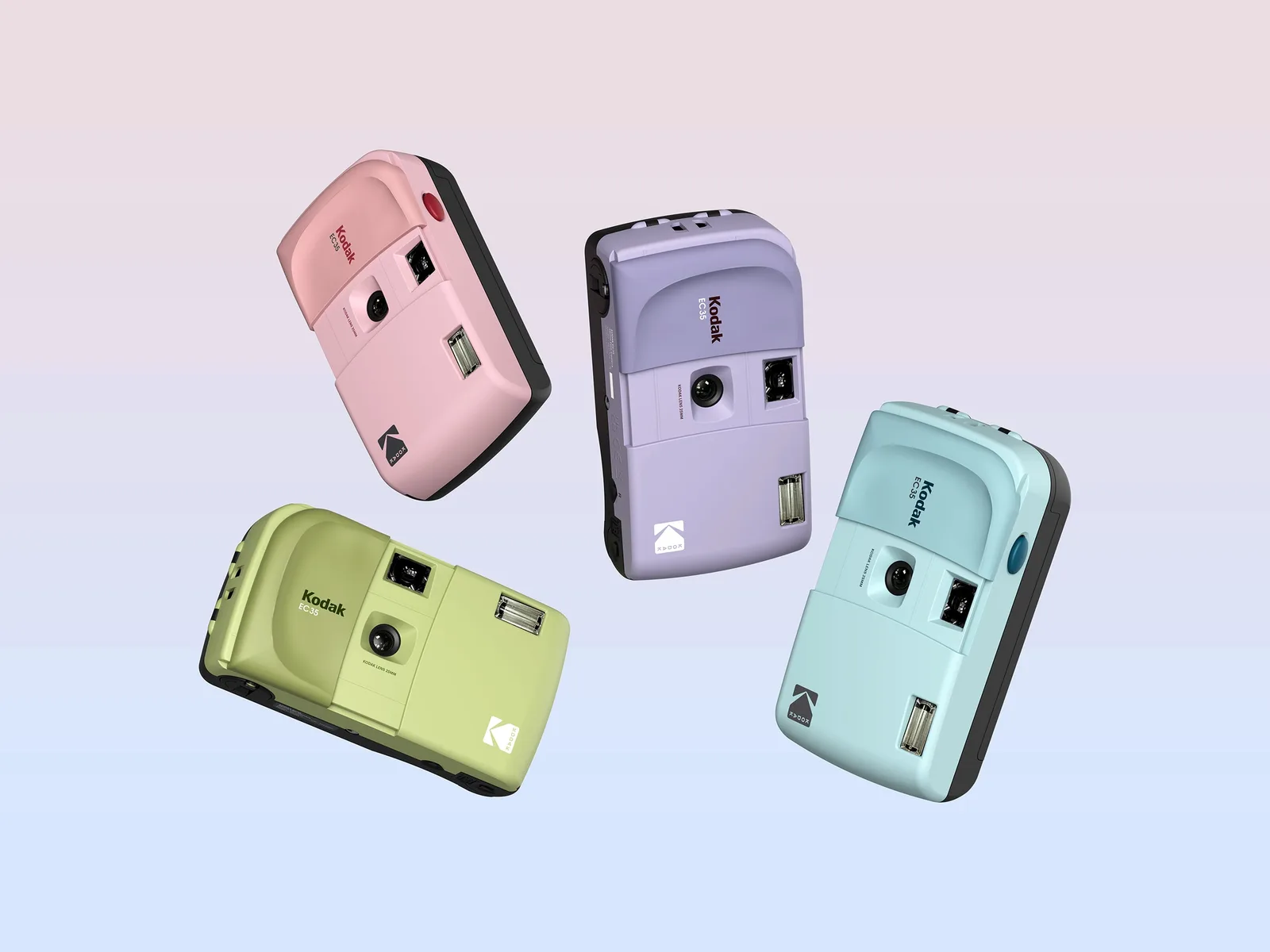
Kodak announced the EC35 on 17 July 2026: a reloadable 35mm point-and-shoot at $34.99, built to do the job a disposable camera does without being thrown away at the end of it. Every write-up so far has covered the same three things — the price, the seven colourways, and the sliding lens cover that doubles as a shutter lock.
None of them covered the decision the camera actually leaves you.
The EC35 has one aperture and one shutter speed. There is no exposure compensation, no ISO dial, no autoexposure. That means the film you load is not a stylistic preference on this camera — it is the exposure control. Load the wrong speed and no amount of careful shooting will save the frame. So this article does the arithmetic, in public, so you can check it.
On a camera with one shutter speed and one aperture, choosing a film stock is not a taste decision. It is the only exposure setting you have.
What Kodak Actually Announced
The specification comes from Reto's official spec sheet, and it is short by design.
| Kodak EC35 | |
|---|---|
| Price | $34.99 / £34.99 camera only · $44.99 / £44.99 with a 24-exposure roll of Ultramax 400 |
| Lens | 25mm, f/10, two-element optical-grade acrylic |
| Shutter | 1/100s, fixed |
| Film transport | Manual wind and rewind |
| Flash | Built-in, powered by 1× AA |
| In the box | Camera and strap. Film and battery are not included |
| Colourways | Midnight Black, Vanilla White, Butter Yellow, Lavender, Powder Blue, Blush Pink, Avocado Green |
| Launched | 17 July 2026 |
One point of accuracy that most coverage skips: the EC35 is designed and manufactured by Reto Production Ltd under a Kodak brand licence. It is not a product of Eastman Kodak, the company that coats film in Rochester. Reto is the same licensee behind the Kodak Ektar H35, the Snapic A1 and the Charmera keychain camera. That is not a criticism — Reto's cameras are competent for what they cost — but "Kodak released a camera" and "a licensee released a camera with Kodak's name on it" are different sentences, and only one of them is true here.
The Arithmetic Nobody Published
An aperture of f/10 and a shutter speed of 1/100s give a fixed exposure value:
EV = log₂(10² ÷ ¹⁄₁₀₀) = log₂(10,000) ≈ 13.3
That number is the scene brightness the EC35 exposes correctly with ISO 100 film. Every doubling of film speed moves the correctly-exposed scene down one stop:
| Film speed | Correctly exposes a scene of | Which in practice is |
|---|---|---|
| ISO 100 | LV 13.3 | Hazy sun, weak shadows |
| ISO 200 | LV 12.3 | Cloudy bright, no shadows |
| ISO 400 | LV 11.3 | Heavy overcast, open shade |
| ISO 800 | LV 10.3 | Late afternoon, dull day |
For reference, open sun on an average subject sits around LV 14 to 15.
Read the table quickly and you might conclude that ISO 100 is the right film for a sunny day. It is the wrong conclusion, and the reason is the most useful thing to understand about shooting a fixed-exposure camera.
Track this in the app: Film Roll Tracker
Why ISO 400 Is the Right Default, Not ISO 100
Colour negative film does not fail symmetrically. Overexpose it by two or three stops and you get dense negatives that scan with slightly flatter contrast and, often, perfectly pleasant colour. Underexpose it by two stops and the shadows fall off the bottom of the curve into mud and colour crossover, and nothing in scanning brings them back.
So on a camera that cannot adjust, you bias toward overexposure deliberately.
With ISO 400 loaded, the EC35 is correctly exposed in heavy overcast and open shade, roughly right on a cloudy-bright day, and around three stops overexposed in open sun. Three stops over is well inside what colour negative absorbs. With ISO 100 loaded, the same camera is correct in hazy sun but two stops underexposed the moment a cloud arrives — and that is the direction that ruins frames.
Which is to say: Reto bundling Ultramax 400 with the camera is the correct call, and the arithmetic supports it rather than contradicting it.
If you shoot indoors or after sunset with the flash, ISO 800 buys you a stop of reach. If you shoot only in full sun and want tighter highlights, ISO 200 is defensible. ISO 100 in a camera you cannot adjust is a trap unless you never shoot outside bright light. Our ISO guide covers how film speed behaves on cameras that do let you compensate.
What Is Not Known Yet
No independent hands-on review of the EC35 exists. Everything published so far — including this article — rests on Reto's press release, its published specification and its own sample images. Nobody outside the company has run a roll through one and looked at the negatives.
That matters for two claims in particular. The two-element acrylic lens will have a character that no spec sheet describes, and fixed-focus cameras vary a lot in where their sharp zone actually falls. Neither can be assessed until real rolls come back. Treat sample images supplied by a manufacturer as marketing, and wait for scans from people who paid for the camera.
We have also seen the claim that several colourways sold out within days of launch. We could not verify it against the store, and no outlet reported it, so we are not repeating it as fact.
Who Should Actually Buy One
The EC35 makes sense if you want the disposable-camera experience — press the button, wind on, do not think — without buying a new camera body every 27 frames. At $34.99 it costs roughly what two or three disposables cost, and it lasts indefinitely.
It makes no sense if you want to learn exposure. A camera that cannot be adjusted cannot teach you what adjusting does. For that you want something with a shutter dial and an aperture ring, which is the argument for spending a little more on one of the 35mm cameras under $100 instead.
And if you already own a phone, note what the EC35's fixed exposure implies: the camera has no meter, so knowing the light before you press the shutter is entirely on you. A light meter telling you the scene is sitting at LV 15 is the difference between knowing you are three stops over and finding out three weeks later.
Log What You Loaded
A fixed-exposure camera produces one specific problem at scan time: every frame was shot at f/10 and 1/100s, so the only variable that explains why some frames worked and others did not is the film, the light, and where you were standing.
Pellica's film roll tracker records the stock, the location and the weather for every frame in one tap. On a camera with no settings, that context is the entire record — and it is what turns a roll of guesses into something you can actually learn from.