
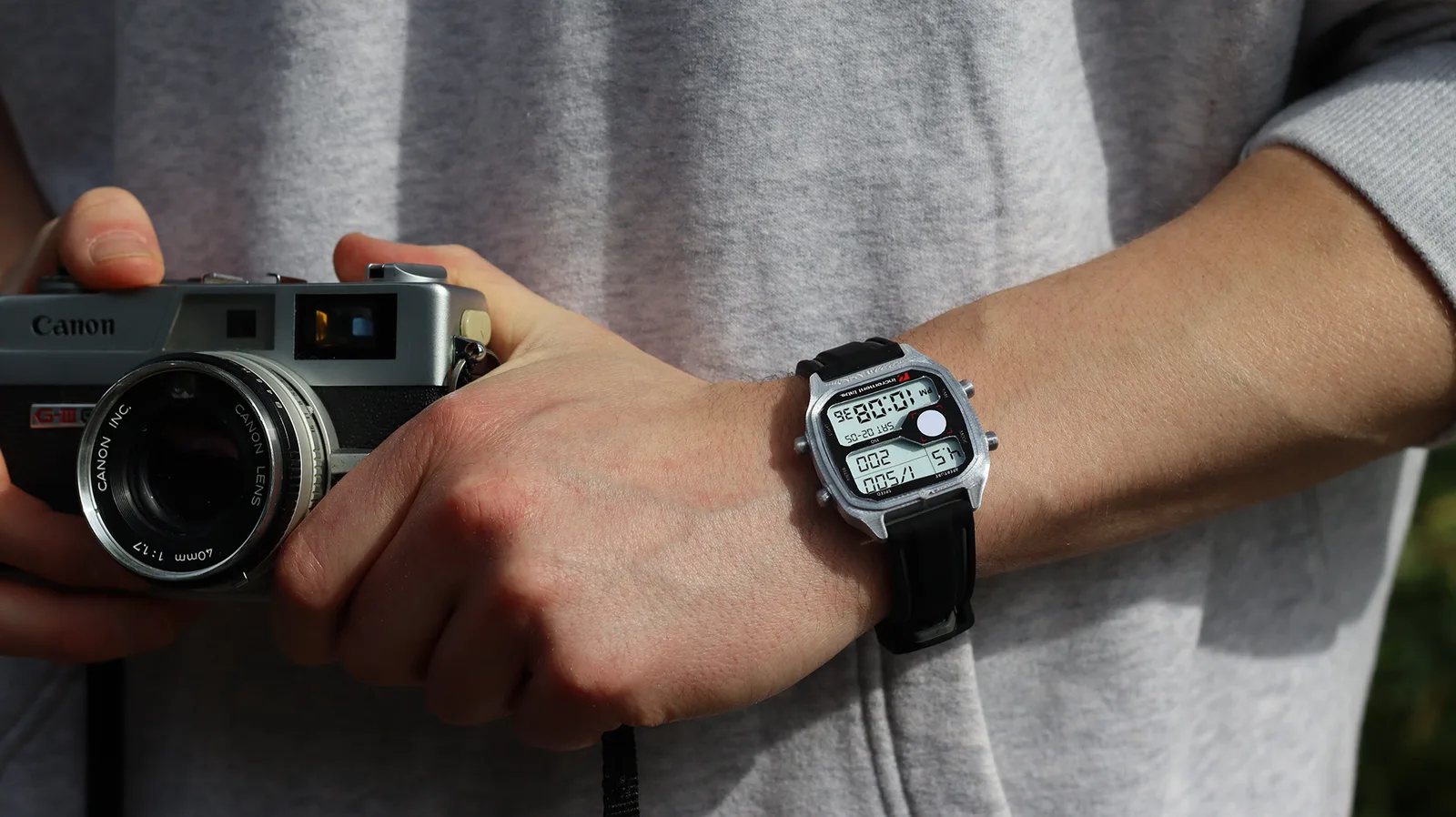
Increment Labs, a three-person company in London, put a light meter inside a wristwatch and asked Kickstarter for £28,875. It hit the target in under a day. As of late July 2026 the campaign page reads £101,980 pledged from 681 backers — roughly 353% of goal — and it is still climbing, because Kickstarter has left late pledges open since the campaign closed on 4 June.
That response is worth taking seriously rather than dismissing, because it is a referendum on something specific: a lot of film photographers do not enjoy metering with a phone.
The LMW-V1 answers a real complaint about phone metering. It also ships in 2027, meters only reflected light, and has no published accuracy figure — three things worth knowing before pledging £119.
What Was Funded
| LMW-V1 | |
|---|---|
| Maker | Increment Labs, London |
| Campaign | 5 May – 4 June 2026, 30 days, Kickstarter "Project We Love" |
| Goal | £28,875 |
| Raised | £101,980 from 681 backers as of late July 2026, still rising via late pledges |
| Backer pricing | £119 Super Early Bird · £139 Early Bird · £159 Limited Edition Black |
| Planned retail | £185 |
| Metering | Reflective, with aperture-priority and shutter-priority modes |
| Display | ISO, aperture and shutter speed alongside time and date |
| Delivery | Stated as early 2027 |
Two figures circulate for this campaign and both are correct at different moments. Kicktraq's final tracked reading at close was £92,172 from 618 backers; the live Kickstarter page now shows £101,980 from 681. The difference is late pledges. Any total you see quoted for the LMW-V1 needs a date attached to it.
The Complaint It Answers Is Legitimate
Richard Soler of Increment Labs has been direct that the product exists because phone metering annoyed him, and on the mechanics of it he is right. Pulling out a phone, waking it, unlocking it, finding the app and waiting for it to load is genuinely slower than pressing a button on your wrist. If you shoot street, that gap is the shot.
There is a second point in their favour that gets less attention. A phone's ambient light sensor and its camera were not designed as photographic instruments, and a phone that is also your map, your music and your camera is a phone whose battery you are rationing. A dedicated device that runs for a month and survives rain does not have that problem.
We are not going to pretend otherwise. Those are real advantages and a wrist-mounted meter is a reasonable thing to want.
Track this in the app: Light Meter
The Three Things The Campaign Does Not Tell You
It is a reflective meter, not an incident meter. This is the limitation that matters most and it is structural, not a version-one gap. A reflective meter reads the light bouncing off your subject, which means it is fooled by exactly the situations where metering is hard: a bright sky behind a person, a dark suit against snow, a backlit portrait. An incident meter — the dome you hold at the subject pointing back at the camera — reads the light falling on the scene and is not fooled by any of that. Sekonic's handheld meters do both. The LMW-V1 does one.
No accuracy figure has been published. There is no stated tolerance in ± EV, no published EV range, and no stated spectral response. For a measuring instrument, those are the specifications. Their absence is not evidence of a bad product, but it does mean nobody outside the company can say how accurate it is.
Nobody has used one. Delivery is stated as early 2027. As of late July 2026 no production unit exists in a customer's hands, no independent test has been run, and every performance claim in circulation traces back to Increment Labs. That is normal for crowdfunding and it is still true.
What It Costs Against the Alternatives
At £119 for early backers and £185 at retail, the LMW-V1 is not competing with free. It is competing with a Sekonic.
A used Sekonic L-308 — incident and reflective, a known quantity, available today — sells second-hand for well under the LMW-V1's retail price. It is not on your wrist, and it is not a watch, and for some people that settles it. But if the goal is accurate metering rather than convenient metering, the handheld with an incident dome is still the instrument that wins, and it has been for forty years.
The phone comparison is different, because there the honest answer is that both approaches have a real edge. The watch wins on speed of access and battery independence. A phone wins on the thing a watch face physically cannot do: show you a scene, remember a reading, and attach it to something.
Metering Is Half the Problem
Here is what neither a watch nor a handheld does. It gives you a number, you use the number, and then the number is gone.
Three weeks later the scans come back and one frame is two stops off. Was the meter wrong, was the lab's push wrong, did you misread it in a hurry, or did you compensate for a backlit subject and overdo it? A meter cannot tell you, because a meter does not remember.
That is the gap Pellica sits in. Its built-in light meter gives you the reading, and the film roll tracker writes it onto the frame — aperture, shutter, ISO, and the light you were standing in — in the same tap. When the scans arrive, every frame carries the decision that produced it.
It is also free, which makes the comparison easy to run yourself: meter a scene with your phone and with whatever you own, and see how far apart they land before spending £185 on a third opinion. Our round-up of light meter apps covers what the free options actually do, and how to use a light meter covers the incident-versus-reflective distinction in more depth than a spec sheet will.
If the LMW-V1 ships in 2027 with a published accuracy tolerance and independent tests back it up, it will be a good product for people who hate phones. Both halves of that sentence are still unresolved.